002 Investigation History & images
Before the Cards
Knew Your Future
How a card game gathered new meanings
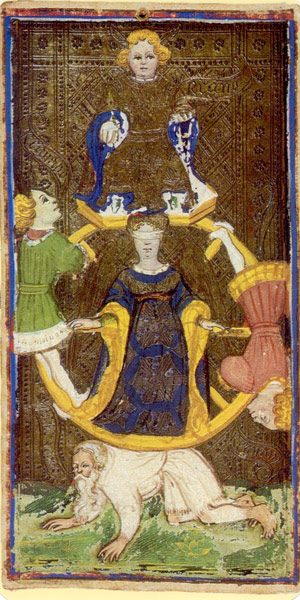 15th century
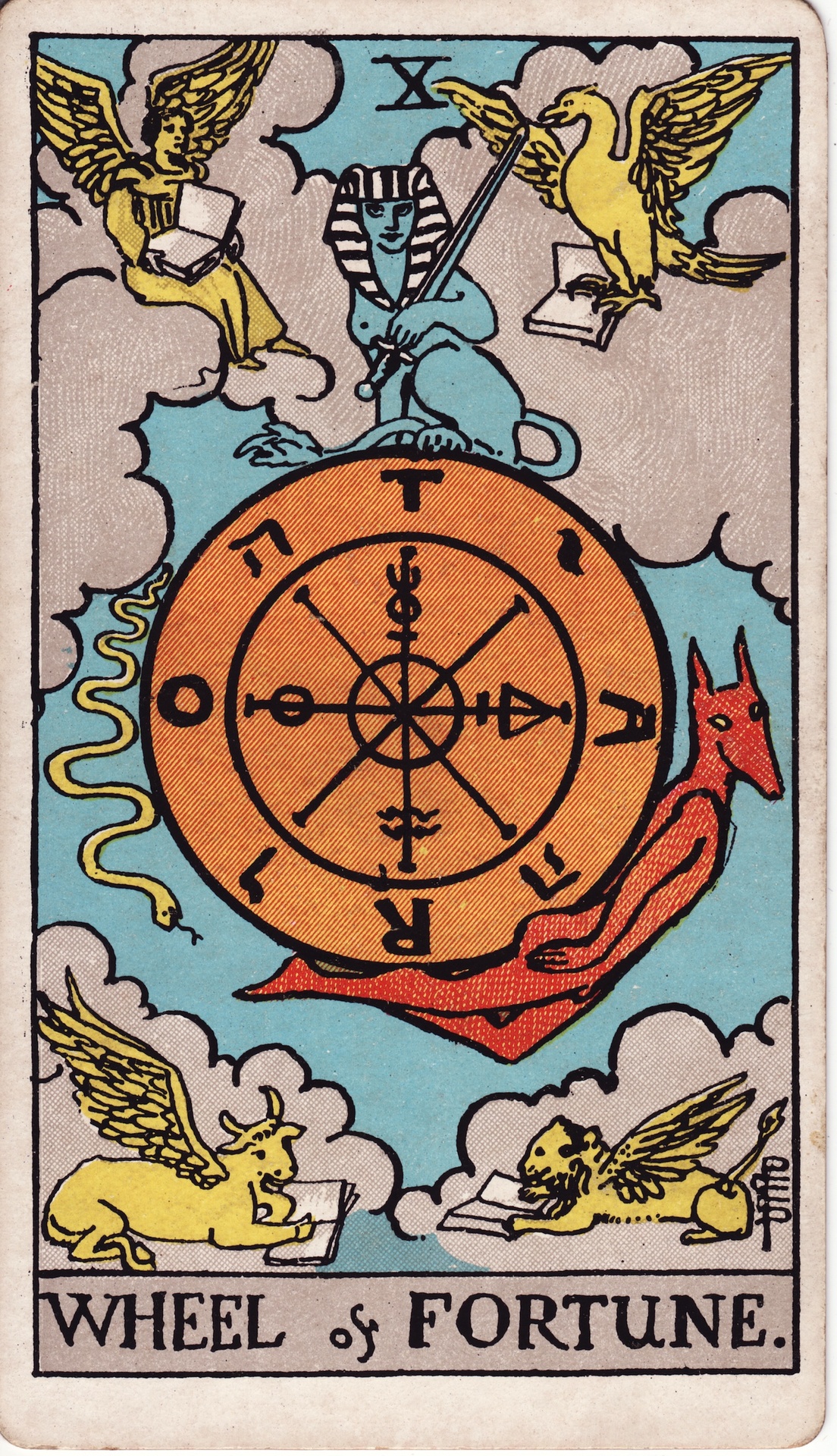 1910 reproduction
Two historical Wheels of Fortune. Full credits and comparisons below.
I spent weeks choosing a tarot deck. I chose a commemorative set celebrating Pamela Colman Smith, whose pictures had already become familiar to me. Then I discovered something I hadn’t expected: the earliest tarot cards were made for a game.
That sent me looking backwards. Before people asked these cards about their futures, what were they looking at? And how did the pictures acquire the meanings that reached my hands?
A game with something already in the pictures
The historical trail leads to fifteenth-century northern Italy. The Metropolitan Museum of Art places the earliest references to tarot in the 1440s and 1450s. These were playing cards, with suits and an additional sequence of trumps used in a trick-taking game. Some surviving decks were costly commissions for courtly patrons. The Met’s account of early tarot gives us a starting point grounded in objects and records.
But a playing card need not be an empty symbol. The Morgan’s curators connect early trump imagery to the visual culture surrounding it: religious authority, social rank, and personifications of forces such as Love, Death and Fortune. Those ideas also appeared beyond card tables, in manuscripts and other artworks. The Morgan: tarot trump imagery
The later history is not a story in which mysterious meanings were added to pictures that previously meant nothing. An emperor already suggested power. A turning wheel already offered a way to picture changing fortune. The question is what people did with those images, and what claims they made for them.
One wheel, two worlds


Early Wheel: Morgan, MS M.630.9. Selected examples, not proof of direct borrowing. Cards shown intact at different display scales; Smith’s deck first appeared in 1909.
Look first at the older Wheel of Fortune. A crowned figure sits at the top; others occupy the sides and the ground below. A blindfolded woman holds the wheel at its centre. Human bodies make the rise and fall visible.
In Smith’s version, the wheel remains, but its surroundings have changed: letters and signs, clouds, winged figures with books, and creatures around its rim. What survives is the wheel. What changes is much of the visual world built around it.
When an origin story became an invitation
In 1781, readers of Monde primitif were offered both a new origin story for tarot and instructions for consulting the cards. Antoine Court de Gébelin argued that the pictures preserved ancient Egyptian sacred knowledge beneath the appearance of a game.
The same volume included an essay by the Count of Mellet, who connected the cards to the Book of Thoth and supplied instructions for divination. This was a consequential proposal: readers could treat a deck as a surviving system of hidden knowledge and learn to consult it. The Morgan: the occult reinterpretation
The Egyptian origin was a claim those writers made, not the origin established by the surviving Renaissance evidence.
Another figure helped turn esoteric interpretation into a usable practice. Jean-Baptiste Alliette, writing as Etteilla, developed a system joining tarot, astrology and divination, and produced a deck around 1789. The reproduced cards and accompanying account in The Public Domain Review show how an interpretation could become a designed object of its own.
Here is part of how an interpretation could travel: printed, illustrated, taught and put into someone else’s hands. An origin story does not have to be historically correct to shape what people subsequently make.
How much of the parlour can we see?
The V&A describes fortune-telling as a parlour amusement in tarot’s later history. That gives us a social setting, but not the particular family scene we might picture, or evidence of reflective journalling like a modern reader’s.
The temptation is to imagine the whole room. The evidence gives us only part of it.
The artist behind the cards
The Rider–Waite–Smith deck appeared in 1909: Arthur Edward Waite conceived it, and Pamela Colman Smith illustrated it. By then, divinatory and esoteric interpretations were already part of tarot’s history. The Morgan’s exhibition account
Six years earlier, Smith had begun publishing and editing The Green Sheaf, a magazine that ran for thirteen issues in 1903–1904. Each issue was hand-coloured at her school of hand-colouring. The Yellow Nineties digital edition lets us look through that earlier work: Smith was already making pictures, words and colour into objects people could take home.
The most revealing way to meet her here is through the pictures: what happens when a numbered suit card becomes a scene?
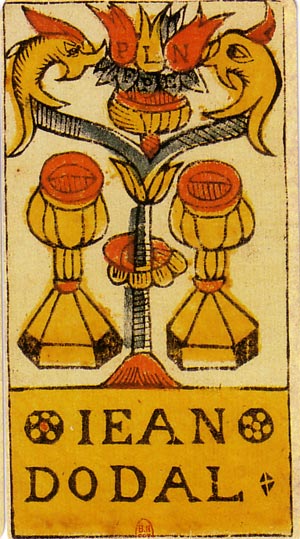

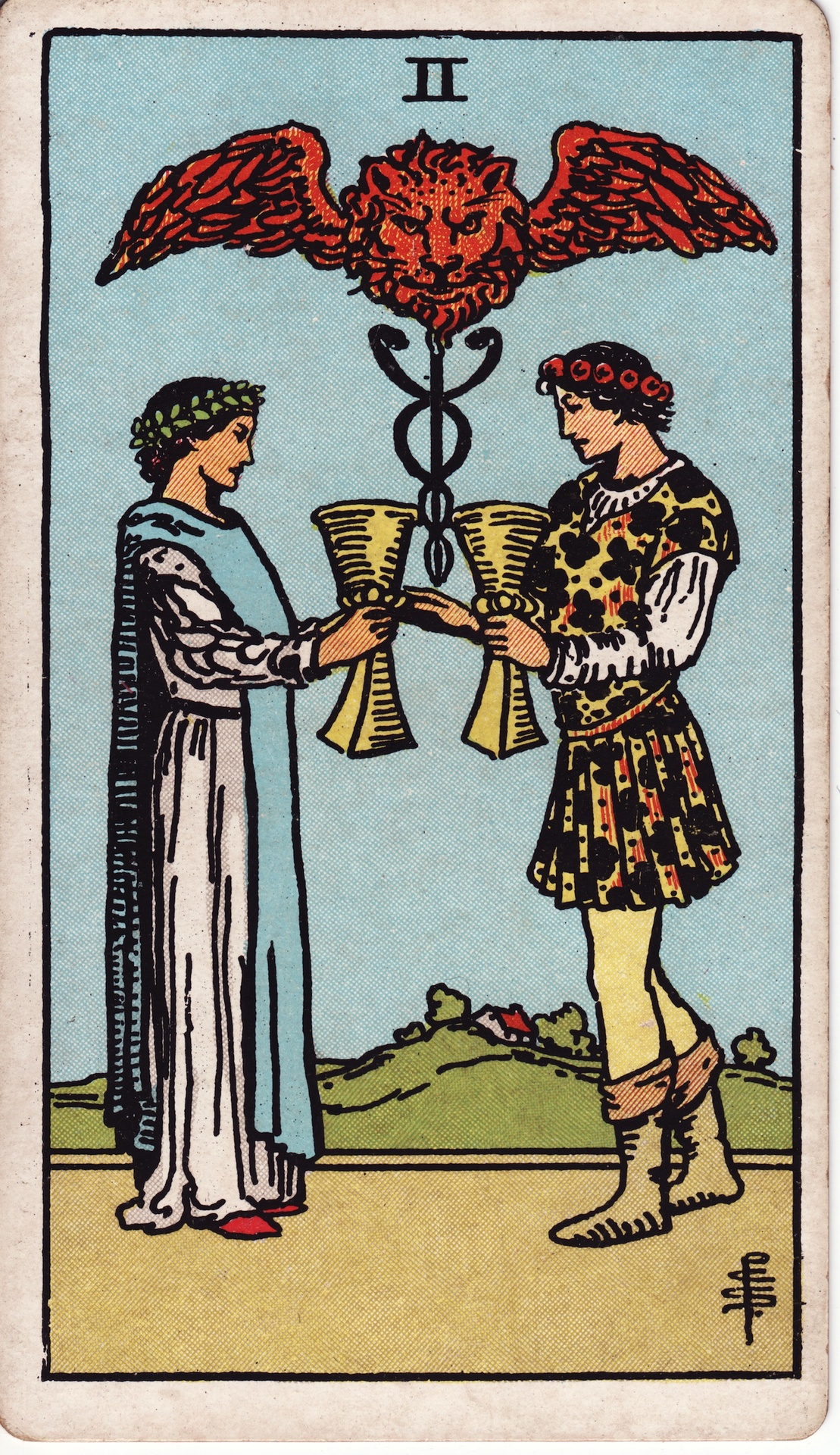

An early-eighteenth-century card beside Smith’s design. This comparison does not represent all earlier suit cards or establish a direct borrowing.
Jean Dodal’s early-eighteenth-century Two of Cups presents two vessels within a decorative design. It is not without detail or character: look at the paired creatures and the maker’s name. Smith’s card puts the cups into people’s hands. Two figures face one another; above them are intertwined snakes, wings and a lion’s head.
Now a viewer can ask about a relationship. Are these people greeting, promising, exchanging, reconciling? The scene invites those questions without settling them.
The objects have become part of an interaction. Gesture, distance and expression give a reader additional material to work with.
Naming Smith beside the pictures matters, too. “Rider–Waite–Smith” lets the illustrator remain visible alongside the publisher and the collaborator whose names also travelled with the deck.
What arrived in my hands
This history cannot decide what a deck should mean to its owner. It can help distinguish an old image from a later explanation, and an artist’s choices from a story about timeless origins.
I began with a deck I had taken time to choose. Looking backwards gave me more to notice in it: the surviving motifs, the changes, and the people involved in making those changes.
A deck can reach your hands carrying several histories at once: the game, the artwork, the interpretations, and the reasons you chose it.
The cards changed. So did what we asked of them.
Sources & scope
This is a historical source review and a comparison of four reproduced cards. It is not a comprehensive history of every tarot tradition, an examination of the physical originals, or an experiment testing divination. The personal opening records the editor’s reason for looking; it is not historical evidence.
Museum essays support the early game context and later reinterpretations. The image captions link to reproduction records and, for the early Wheel, the Morgan’s object record. The Smith deck was first published in 1909; Commons dates the two reproductions used here to 1910.
The visual observations are ours. The pairs are selected examples, not a complete family tree of designs or proof of direct borrowing. They do not establish each artist’s intentions or every reader’s beliefs. We are not claiming that Smith invented illustrated suit cards.
All four reproductions are identified as public domain on their linked Wikimedia Commons file pages. No cards in this article are AI-generated.
After the investigation
What survived the check
Early tarot is documented as a Renaissance card game. Later writers developed esoteric interpretations and divinatory systems. Comparing the cards makes both inherited motifs and deliberate visual changes visible.
What we couldn’t establish
These sources do not recover every early user’s experience, every artist’s intention, or one fixed meaning for a card. Predictive accuracy was not tested. Family tarot journalling in Smith’s period was not established by this review.
What remains strange
A deck can retain recognisable images while people change the questions they bring to it. The object passes on; the uses and meanings continue to accumulate.