003 · Investigation · Human nature
The Word That Was
Always There
Why does something familiar suddenly catch our attention?
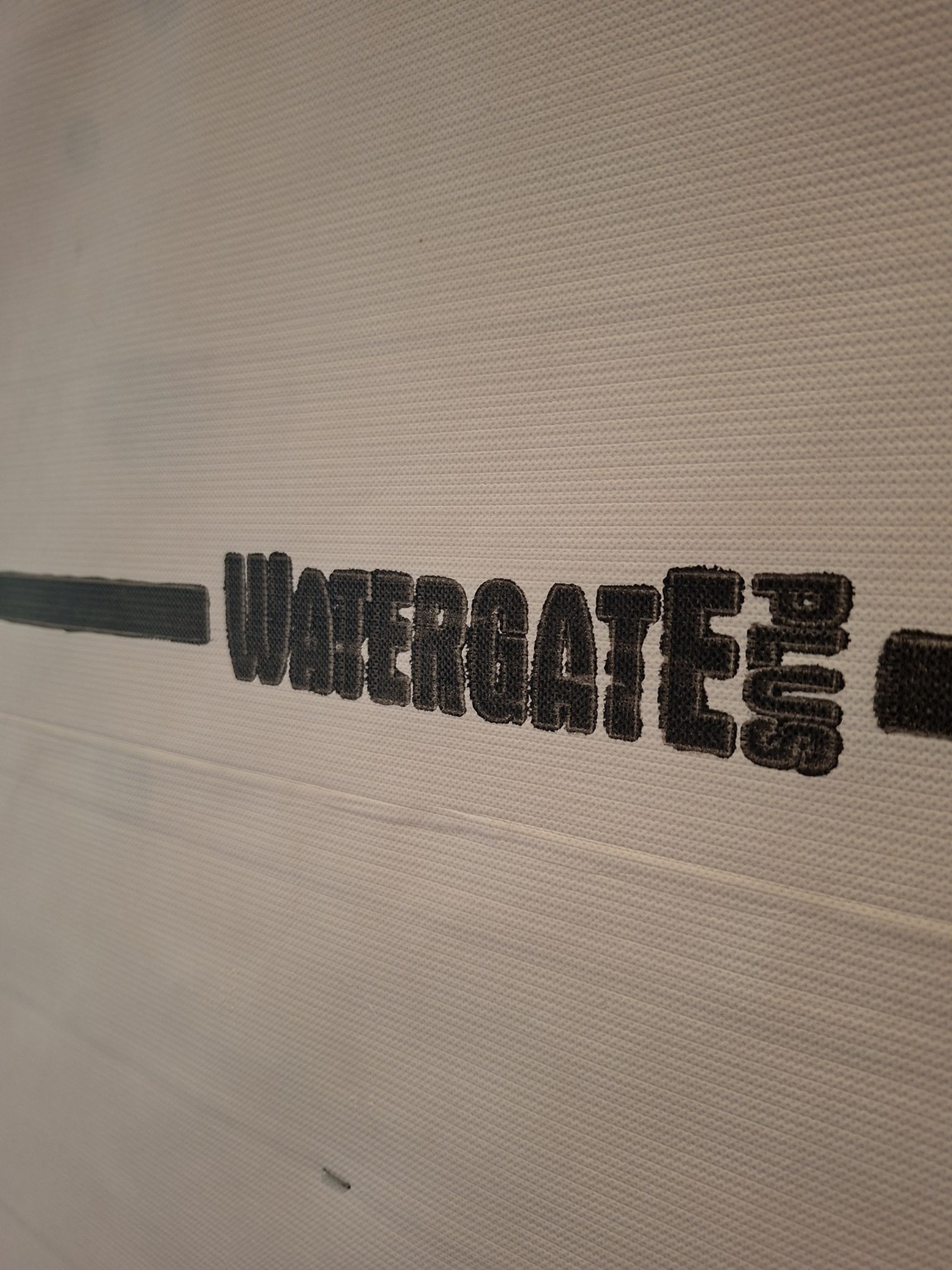
Photograph by the editor.
After a morning discussing politics, government secrets and scandals, I happened to glance up while on the stairs.
WATERGATE.
Printed right across the wall.
I burst out laughing. Of all the words to notice that morning.
It was building wrap. But I'd been past that wall so many times. Had I overlooked the lettering before? Seen it and forgotten?
Only afterwards did we look into the original Watergate scandal. The word on the wall had sent us into the history.
It turns out those are rather different questions.
Wouldn't you notice a gorilla?
I remember watching the famous gorilla experiment and thinking: surely people would notice someone in a gorilla suit.
In Daniel Simons and Christopher Chabris's 1999 study, people watched a video and monitored basketball passes. An unexpected figure appeared during the action. Some viewers missed it while concentrating on their task; how often they noticed depended on the conditions. Read the original study
The phenomenon is called *inattentional blindness*: something can be visible without being consciously noticed when attention is occupied elsewhere.
Knowing what to look for changes the experience of watching. Once you know about the gorilla, it is hard to recover the surprise of someone who was simply trying to count passes.
But my wall raised another possibility. Perhaps I had noticed the lettering before. Perhaps I just hadn't kept much of it.
The mannequin in the staffroom
Years ago, when I ran workplace training, I dressed a mannequin and left it in the staffroom for about two weeks.
Before a training morning, I removed it. Then I asked people what it had been wearing.
I remember being surprised by how difficult they found it. I don't now remember whether anyone got everything right. It was a long time ago, and an informal exercise rather than a controlled experiment.
Still, it is a question you can almost feel yourself trying to answer. You know the mannequin. You have passed it. But the clothes? The details?
A study of an everyday coin explored a related gap. In 1979, Raymond Nickerson and Marilyn Jager Adams asked people to draw an American penny from memory, identify its features and distinguish accurate drawings from incorrect ones. Performance was poor despite the object's familiarity. Read the original paper
Recognising something is not the same as remembering its details. A familiar object needn't leave a complete picture behind.
That is what makes the staircase question interesting. “I don't remember noticing it” cannot tell me whether I never noticed it at all.
Why that word, that day?
The tempting explanation is that the morning's discussion made a word associated with scandal stand out. It may have. But I have no record of my earlier glances, or what I noticed and promptly forgot.
This also differs from the *frequency illusion*: the feeling that a word or idea is suddenly turning up everywhere after it first catches your attention. Here, I had one striking encounter, not a run of them. Arnold Zwicky on the term
I can't reconstruct that moment in my mind precisely. I can follow the question it left behind.
A small detail at the other Watergate
Before Watergate became the name of a scandal, it was the name of a complex in Washington, DC. On 17 June 1972, five burglars were caught in the Democratic National Committee's offices there. The subsequent investigation exposed wrongdoing reaching into Richard Nixon's administration. Nixon resigned under threat of impeachment on 9 August 1974. National Archives: Nixon and Watergate
The discovery of the break-in involved a particularly telling detail. Security guard Frank Wills noticed tape covering a door lock and removed it. When he returned and found that tape had been replaced, he contacted the authorities. His security log survives in the National Archives. Read about Wills and the discovery
Wills was responding to evidence that something had been interfered with. My experience was a familiar word suddenly becoming interesting. The connection is a historical coincidence, not a shared psychological finding.
But it was an unexpected place for a piece of building wrap to send me: from my own wall to a staffroom mannequin, a laboratory experiment and a security guard's log.
There is something rather pleasing about that. You don't always need to go somewhere unfamiliar to find a question.
Sometimes you need a second look at where you already are.
Sources & scope
Sources checked 16 October 2026. This piece connects a personal observation with research on attention and memory. The controlled studies do not establish the cause of the staircase experience. Zwicky's account supplies terminology; the National Archives supplies historical context. The workplace story is recalled from years ago, with its uncertainty preserved and identifying details omitted.
After the investigation
What survived the check
People can miss visible events while attention is occupied elsewhere. Familiar objects can also be remembered in surprisingly little detail. These are different findings, both relevant to the questions we ask about everyday noticing.
What we couldn't establish
Whether I had noticed the word before, or whether our conversation caused it to stand out that day. The mannequin exercise has no recorded results here; it is a recollection, not evidence of a measured effect.
What remains strange
An ordinary room can still surprise the person who lives in it.